
At a glance
- Typical fee
- CoR39 has a nil prescribed filing fee; CIPC lists the manual form as free. Private assistance, data, printing and separate company transactions are additional costs where applicable.
- Processing time
- File within ten business days after the change. Conditional 2026/27 benchmarks: automated immediate after director OTPs; back-office one day and manual three days from tracking/indexing. Verification and outstanding consents add time. No universal appointment OTP expiry confirmed.
- Difficulty
- Moderate
- Authority
- Companies and Intellectual Property Commission (CIPC)
The CIPC director appointment process starts with a lawful company decision and the appointee’s written acceptance, followed by a director-amendment filing with CIPC. Use the CoR39 service, check identity and contact details, complete the required consents and verify the resulting record. The prescribed notice must be filed within ten business days after the change and has a nil prescribed filing fee.
This guide concerns adding a director to an existing South African company. It is not a close-corporation member amendment or a co-operative director return. If you are forming a new NPC, start with our CIPC nonprofit company registration guide and its initial-director requirements.
What changed in October 2026?
CIPC Notice 51 of 2026 announced a phased update for 16 October 2026. Its first phase covers small companies whose directors and shareholders are the same individuals. A majority of the board must confirm each newly appointed director by OTP within the required timeframe, otherwise the application is terminated.
The notice does not publish one numerical OTP expiry period for every appointment. Follow the deadline and confirmation requests displayed in your transaction. Older screenshots may show different consent rules or layouts; they are useful for orientation, but cannot establish that a current application is complete.
Who can be appointed, and who can decide?
Check the Companies Act’s director provisions and the company’s Memorandum of Incorporation (MOI). The candidate must be a natural person who meets the applicable eligibility requirements and is not disqualified. An unemancipated minor is ineligible, and the MOI may impose additional qualifications. Obtain advice if insolvency, a court order or another possible disqualification is involved.
Identify the lawful appointment or election route. Shareholder election, direct appointment under the MOI and temporary board filling of a vacancy have different rules. Do not assume that a board resolution alone authorises every permanent appointment. CIPC’s OTP confirmation control is separate from the underlying company decision.
Documents and information to prepare
- Company name, registration number, MOI and existing director particulars.
- The valid appointment/election decision, relevant resolution and meeting records.
- The new director’s signed written acceptance of office.
- Correct names, ID or passport details, appointment date, addresses and contact information.
- Identity evidence for the filer and affected directors, with certified copies where the selected route requires them.
- A company mandate where a third party files on its behalf.
- Access to the relevant personal email addresses and mobile numbers for verification and consent.
CIPC’s maintenance requirements distinguish documentary submissions from electronic processing. Keep governance records even where an automated transaction does not request every upload. Manual requirements include all-director signatures on the resolution/minutes; seek clarification if you cannot lawfully supply what that route requests. Never sign for someone else.
CIPC director appointment process: seven practical steps
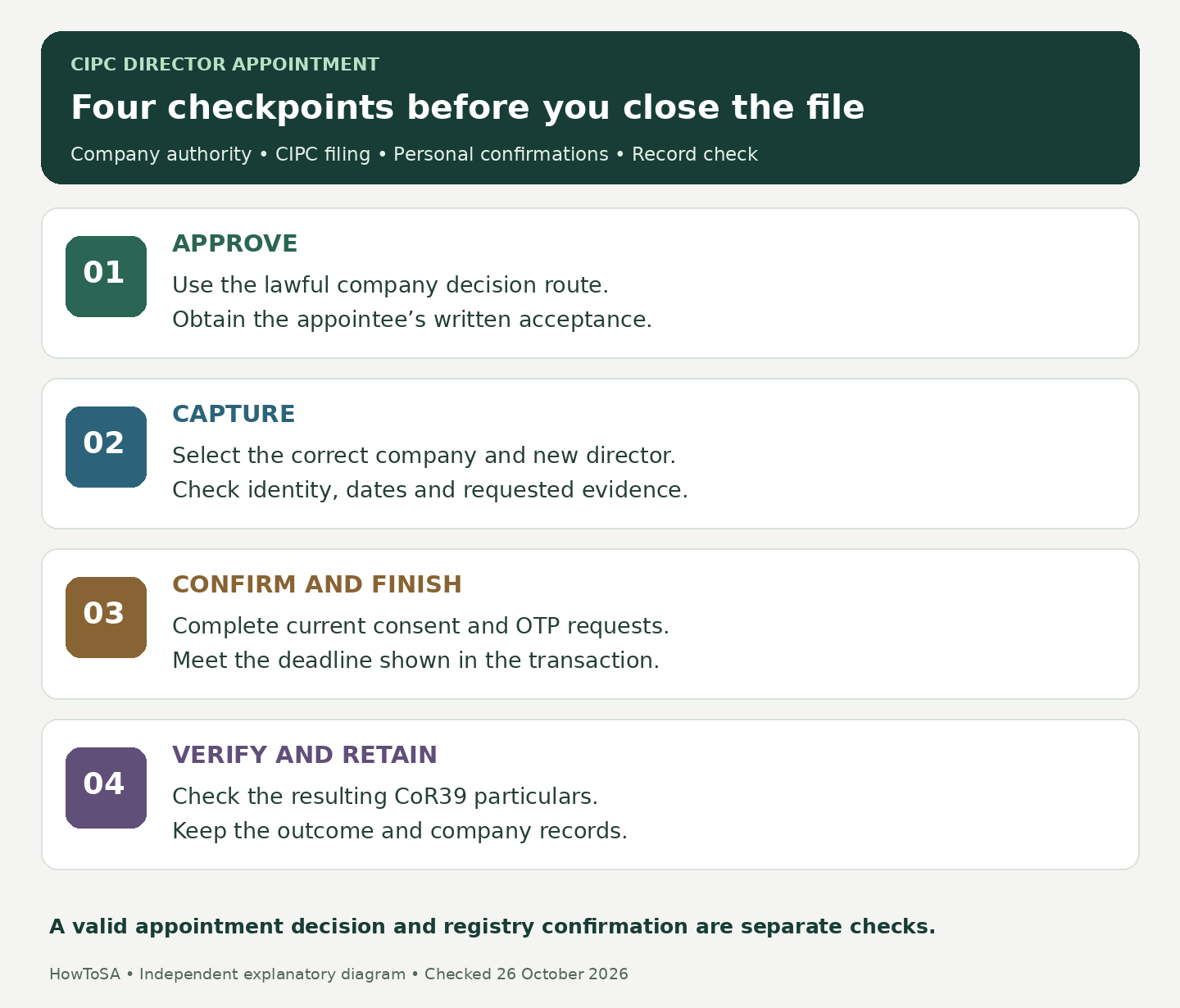
1. Approve the appointment and obtain written acceptance
Complete the applicable company decision and record its effective date. Ensure the person has delivered written consent to serve. Keep the supporting decision and acceptance together so the captured appointment date can be explained later.
CIPC’s unauthorised-change practice notice calls for a signed acceptance letter. It also requires both directors to co-sign the resolution when a sole director resigns simultaneously with a replacement’s appointment. That special situation needs careful preparation; do not use an appointment transaction to disguise a disputed removal.
2. Prepare identity verification and working contact details
Make sure the filer can access the official account and that the candidate’s details match their identity records. Our CIPC customer registration guide helps new filers; use the password-reset guide for an existing account.
The CIPC verification guide directs an unverified foreign passport through Foreigner Assurance before continuing with CoR39. Check expiry and verification status early. Foreign nationality does not, by itself, tell you which final processing route the application will use.
CIPC’s December 2025 practice note also protects contact-detail changes and provides for notifying other directors. Resolve incorrect records through the official contact-change function. A contact-change objection period is not an appointment OTP deadline.
3. Open the correct company in eServices
Enter CIPC eServices through the official website. The published automated guide uses Transact, More Services and Director Amendments. Complete customer verification if requested, then search using the company registration number.
Check the displayed name and number before filing. Review the current director list. Preserve unchanged entries and select the appropriate no-change option where required; an appointment does not require resigning an existing director.
4. Capture the new director’s particulars
Select the new-director appointment option and follow the appropriate South African ID or passport verification prompts. Supply the requested details and actual appointment date consistently with the company records. If identity verification is unavailable or fails, retain the error and resolve it rather than substituting another identifier.
Prepare readable attachments where requested. Upload requirements depend on the transaction and route. Check that every requested file has actually attached before continuing, and keep a local copy of the submitted pack.
5. Review and submit the proposed change once
Read the summary carefully: company, appointee, identity number, effective date, contact details and any changes to existing directors. Correct discrepancies before confirmation. Save the reference and submission acknowledgement.
A useful practical check is to ask the appointee to compare the summary with the signed acceptance and identity record. Do this before requesting confirmations. Avoid repeated submissions while waiting for one transaction to finish.
6. Complete the required consents and finalise
Each requested participant should review the proposed changes and complete their own official confirmation. Satisfy the current majority-board requirement where the phased process applies, together with the other consent and filer checks shown. Monitor the application’s confirmation status and displayed expiry time.
The published guides include a final Finish action after the required consents. Follow the current screen’s finalisation instructions rather than assuming that entering one OTP completed the application. Review any pending or rejected confirmation. If somebody disputes the proposed appointment, resolve the authority issue; do not manufacture consent.
7. Verify the CoR39 outcome and retain the record
Obtain the completed CoR39 outcome and compare the company, director and appointment particulars with the approved submission. Back-office cases require approval before the outcome is issued. Keep the result, reference, decision, written acceptance and supporting correspondence together.
Update the company’s own director records and any separate records affected by the change. Check ownership or control reporting separately where relevant; recording an appointment does not itself transfer shares. A submitted or pending status is not evidence that CIPC’s register has been updated.
Fees, filing deadline and processing time
Fee: CoR39 specifies no prescribed filing fee; the current forms-and-fees table lists the manual form as free. Private assistance, data, printing and separate transactions can still involve costs.
Filing: Notice 25 of 2026 reiterates the ten-business-day requirement for director changes. This is a filing obligation, not CIPC’s processing promise.
The 2026/27 service standards are conditional benchmarks for 90% of accurate, complete filings:
| Route | Published benchmark |
|---|---|
| Automated | Immediate after directors submit OTPs |
| Back office | One day from tracking and indexing |
| Manual | Three days from tracking and indexing |
These are not guarantees measured from starting a form. Identity verification, missing documents, pending confirmations or technical problems can add time.
Common failures and fixes
- Wrong company selected: compare the full registration number before confirming.
- ID or passport mismatch: check the original details and complete the official verification route.
- OTP does not arrive: check the recorded email/mobile details and spam folder, then use the available resend or support route.
- Some confirmations remain outstanding: identify the missing participant and actual deadline; a filer’s OTP alone may be insufficient.
- Application terminated: retain the reason and reference, correct the cause and confirm whether a new filing is needed.
- Details in the outcome are wrong: report the precise discrepancy with the reference and supporting records.
Official help, escalation and unauthorised changes
Use CIPC’s enquiry system for a service query, supplying the reference, company number, filing date, route, error and relevant evidence. For delays, check the applicable service standard first. If online access fails, the published call-centre number is 086 100 2472. Never include passwords or OTPs in a query.
The service-standards page lists automated/back-office escalations to Thomas Lebete, TLebete@cipc.co.za, then Vuyani Nkohla, VNkohla@cipc.co.za. Quote the earlier enquiry reference and recheck current responsibilities before escalating.
If a change was unauthorised, preserve the notices and records. CIPC’s fraud reporting page includes unauthorised entity changes and customer-code misuse, with toll-free 0800 008 885. A report does not automatically reverse a director entry or settle a company dispute; obtain case-specific advice where authority is contested.
Official sources checked
Checked on 26 October 2026. The October 2026 notice takes precedence over older screenshot instructions where the phased controls apply. No universal appointment OTP expiry period was verified.
- CIPC Notice 51 of 2026: director amendment process
- CIPC Notice 25 of 2026: accurate and up-to-date director information
- CIPC CoR39: notice of change of directors
- Companies Act 71 of 2008, provided by CIPC
- CIPC Practice Notice 2 of 2021: preventing unauthorised director changes
- CIPC Practice Note 6 of 2025: director contact and amendment controls
- CIPC automated director-amendment guide
- CIPC back-office director-amendment guide
- CIPC enterprise maintenance: director amendments
- CIPC company forms and fees
- CIPC 2026/27 service delivery standards
- CIPC eServices portal
- CIPC fraud hotline portal
HowToSA is an independent information site, not CIPC or a law firm. This guide is general information. The Companies Act as amended, the company’s MOI, current CIPC instructions and case-specific decisions govern the appointment and filing.
Accuracy note: 26 October 2026: verified appointment-specific filing and the 16 October phased majority-board OTP controls. Distinguished lawful company authority from registry confirmation, automated from back-office/manual requirements, and the ten-business-day filing duty from processing standards. No fixed universal OTP expiry or guaranteed completion time supplied. Editorial review 14 November 2026: CIPC board director filing and October 2026 phased OTP verification controls reviewed; 10-business-day notification and authorisation remain distinct.