
At a glance
- Typical fee
- SAPS copy certification is free (R0). Bring your own photocopies. Copying, printing and travel are separate costs. Specialised notarial or legalisation processes have separate requirements to check.
- Processing time
- No national guaranteed completion period verified. In-person waiting depends on the queue, authorised official and number of documents. Certification-age and submission requirements depend on the receiving institution; no universal three- or six-month expiry asserted.
- Difficulty
- Easy
- Authority
- South African Police Service (SAPS); Department of Justice and Constitutional Development for Commissioner of Oaths designation
To get certified copies in South Africa, take the original documents and clear photocopies to a police station or another authorised Commissioner of Oaths. The official compares the copies with the originals and completes the certification. SAPS states that this service is free. Before travelling, check whether the receiving institution needs certified copies, how recent the certification must be and whether it accepts a scanned submission.
Bring your own copies. The SAPS 2026 PAIA Manual lists certification as a free service but says the person must bring the original document and copies. Preparing the correct pack helps avoid a second trip.
What do certified copies confirm?
A certified copy records that the copy corresponds with the original presented. It does not, by itself, prove that every statement in the original is true or that a qualification is genuine. The DPSA’s original certification circular expressly distinguishes copy certification from checking the authenticity of the underlying document.
Certification also differs from making a sworn statement. If an application asks you to explain facts under oath, use our South African affidavit guide. A certified ID copy and an affidavit may be requested for different purposes within the same application.
What to take for certification
- The originals: the actual records to be compared, such as an ID, passport or paper qualification.
- Clear photocopies: the required number of sets, including relevant reverse sides and annexures.
- The recipient’s instructions: its checklist, advertisement or email, especially any certification-age or layout requirement.
- Identification or authority if requested: check arrangements beforehand if presenting another person’s records.
- A protective folder: keep originals separate from copies to be submitted.
The last items are practical preparation, not a universal SAPS application form or extra fee. For a company filing, for example, our CIPC director appointment guide explains why document requirements depend on the filing route. Certification does not complete that separate transaction.
How to get certified copies: six steps
1. Confirm exactly what the receiving institution wants
Read the current instructions before copying a large pack. Ask which documents need certification, how many sets are required, which certifiers it accepts and whether it needs paper copies or an uploaded scan. Check whether the request applies now or only at a later stage.
Keep the answer with your application notes. If the wording is unclear, request clarification from the institution rather than relying on another applicant’s experience. Different applications can legitimately request different evidence.
2. Prepare complete, readable originals and copies
Copy all relevant information without cutting off edges, dates, photographs or document numbers. For a card with information on both sides, include both sides and check the recipient’s requested layout. Keep multi-page documents in order and include the pages the application actually requires.
Compare the copies yourself first. Replace faint, blurred or incomplete pages before the visit. Sort each original beside its copies so the official can compare them efficiently. Do not rely on a photocopied certification stamp from an earlier pack as a fresh certification.
3. Use a police station or another authorised commissioner
SAPS publishes that copies can be certified at any police station, at any time. Ask the community service centre for the authorised official providing certification. Allow for local queues and availability, particularly if you have a large bundle.
The Department of Justice explains that Commissioners of Oaths may certify copies and can be personally designated or authorised through a qualifying office. An office-holder’s authority depends on that designation; do not assume that any person with a professional title can certify for every purpose. Check their capacity and the recipient’s acceptance if uncertain.
4. Present the originals for comparison
Give the official the original and corresponding copies. Explain which institution requested them and show any special instructions. Leave the certification wording, signature and official particulars to the authorised person.
If a page is missing, illegible or inconsistent, correct the problem rather than asking for it to be overlooked. Tell the official if the document exists only electronically. A photo or printout should not be presented as a paper original that you do not have.
5. Check the completed copies before leaving
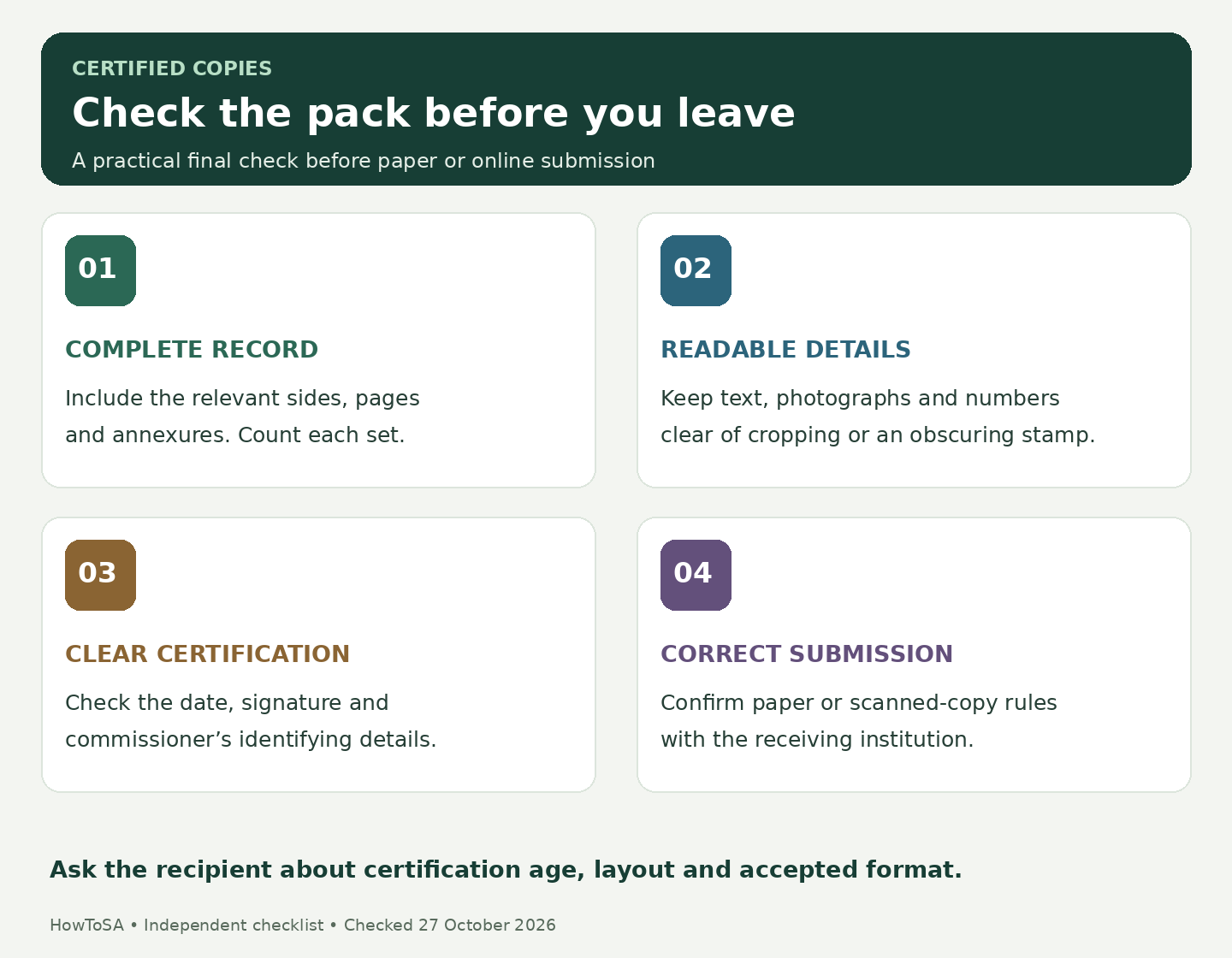
Check that the certification is legible, dated and signed, and that the commissioner’s identifying details are readable. Ensure the wording or stamp does not hide important information. Count the pages and sets, and collect every original.
For a multi-page record, confirm that the certification method meets the recipient’s requirements. Do not assume one stamp covers an unrelated bundle. If something is missing, ask the official to correct it; do not add a signature, stamp or certification date yourself.
6. Submit the required version and keep the originals
If electronic submission is accepted, scan the full certified page with all certification details visible. Open the resulting file to check every page before uploading. Follow the portal’s actual format, size and naming instructions.
A scan or photocopy of a certified page may not satisfy a request for the originally certified paper copy. Confirm what the recipient accepts. Keep your own record of what was submitted and any acknowledgement, and retain the originals unless the specific application requires them.
Do certified copies expire after three or six months?
Do not apply one age limit to every South African application. Distinguish the date of certification from the expiry of the underlying document. A fresh certification cannot extend an expired passport’s validity.
The Presidency’s 19 November 2019 announcement, reflecting DPSA Circular 35/2019, advised public-service employers to accept copies up to six months old where the document itself did not expire within that period. This concerned employment applications; it was not a universal six-month expiry rule for all certified copies.
As a separate example, the Air Services Licensing Council’s 2023 Gazette requirements specify their own three-calendar-month age and ID-layout rules. Those are recipient-specific requirements, not instructions for every institution.
Also check whether certification is required at the first application stage. A 2026 DWYPD advertisement published by DPSA requests certified documents only from shortlisted candidates following HR communication. Follow the current advertisement and HR instructions for the post you are applying for.
Electronic records, lost originals and international use
For an electronically issued bank statement, company record or certificate, ask how the issuer’s source must be demonstrated. Keep the original email, official PDF or portal record available. The ASLC notice illustrates a recipient-specific process for checking electronic sources; it does not guarantee that any printout will be accepted everywhere.
If a paper original is lost, ask the issuing institution about a replacement or an accepted verification route. An affidavit about the loss does not recreate the original record. Check with the recipient before treating an old photocopy as sufficient.
For overseas use, confirm the destination’s requirements first. DIRCO’s legalisation guidance distinguishes authentication/apostille procedures and says its Legalisation Section does not authenticate ordinary certified copies of the listed public documents. A police certification stamp alone does not establish compliance with an overseas application.
Fees and timing
SAPS copy certification is free: R0. Photocopying, printing and travel are separate expenses. Bring prepared copies rather than relying on a station to produce the photocopies. Check separate notarial or legalisation requirements if those are what the recipient requests.
No national guaranteed completion period was established in the checked sources. Allow time for the queue, the available authorised official and the number of documents. If a deadline is close, ask the recipient about acceptable alternatives or arrangements; do not assume that a certification visit extends its deadline.
Common failures and fixes
- No original available: explain whether it is lost or electronic-only and confirm an accepted source-verification route.
- Missing reverse side or annexure: make complete copies before certification.
- Faint details or cropped stamp: replace the poor copy or rescan the full certified page.
- Certification too old for this application: check the actual requirement and obtain a fresh certification if needed.
- One stamp on an unclear bundle: ask the recipient and commissioner how the pages must be certified or identified.
- Wrong document process: distinguish copy certification, an affidavit, qualification verification and international legalisation.
Official help and service complaints
For an acceptance problem, first ask the receiving institution which requirement is unmet. For a police-station service issue, ask the community service centre or Station Commander for assistance. The SAPS Service Complaints Centre lists local, district and provincial channels.
If local or provincial attempts do not resolve it, the national service-complaint contacts list 0800 333 177 and complaintsnodalpoint@saps.gov.za. Provide the station, visit date and time, relevant member details if known, what happened and the assistance sought. Keep your enquiry record and use official channels for personal information.
Official sources checked
Checked on 27 October 2026. Recipient-specific and dated examples are identified above; use the latest requirements for your own application.
- SAPS: certification of documents
- SAPS PAIA Manual 2026
- Department of Justice: Commissioners of Oaths
- Government Gazette 49079, 4 August 2023: ASLC certification requirements
- DPSA HRP and Employment Practices Circular 35 of 2019
- The Presidency: public-service document certification announcement, 19 November 2019
- DPSA Public Service Vacancy Circular 38 of 2026, Annexure R: DWYPD
- DIRCO: legalisation services
- SAPS Service Complaints Centre
- SAPS: national service-complaint contacts
HowToSA is an independent information site, not SAPS, the Department of Justice or the receiving institution. This guide covers ordinary copy certification. The recipient’s current requirements and any applicable specialised process take precedence.
Accuracy note: 27 October 2026: confirmed the free SAPS route, original-and-copy preparation and authorised commissioner role. Distinguished true-copy comparison from underlying authenticity; employment-specific age guidance from recipient rules; and electronic/international document processes. SAPS direct pages returned HTTP 503, so their official indexed text was checked alongside current official PDFs and Justice guidance.