At a glance
- Typical fee
- The August 2026 DHA tariff lists R1,520 for a section 19 work visa. VFS’s revised South Africa service fee notice sets R1,750 inclusive of taxes from 22 June 2026 where a service charge applies, superseding R1,550 in the older category table. Budget R3,270 when both charges apply, before optional or document costs. Confirm the actual amount, currency and payment method with the filing office.
- Processing time
- Assessment time varies. Ask the receiving mission or intake office for its current estimate for a complete ICT application, allowing separately for the appointment, document checks and passport return. Four years is maximum visa validity, not processing time. The ICT visa is non-renewable.
- Difficulty
- Complex
- Authority
- Department of Home Affairs (DHA); South African missions abroad and DHA’s designated application intake provider for the relevant submission channel
The intra-company transfer work visa process is for an employee already working for a company abroad who is being assigned to its South African branch, subsidiary or affiliate. Start with the overseas employment contract, a letter from each company and the South African host’s plan to transfer skills. Apply through the South African mission responsible for your application unless Home Affairs confirms that you can apply inside South Africa. The visa is tied to the approved work and employer, lasts up to four years and cannot be renewed.
This guide covers the ordinary section 19(5) route, checked on 5 November 2026. If your employer uses a special scheme, ask the mission for its separate checklist.
Who qualifies for the intra-company transfer work visa process?
The Immigration Act, section 19(5) and (6), sets out the visa and restricts work to the employer and terms of the visa. The Immigration Regulations, regulation 18, require evidence of the existing overseas employment and a transfer within the company group. A new job offer from an unrelated South African employer does not establish that relationship.
Regulation 18 requires a foreign employment contract valid for at least six months. The government’s Home Affairs yearbook also describes a minimum of six months of prior employment with the foreign office. Have evidence of your actual employment history ready, especially if your contract has recently changed or you have joined the employer recently. Ask the mission to confirm eligibility before paying if either the employment history or the contract period is unclear.
Documents and information to prepare
Download the current checklist for the place where you will lodge. The core transfer evidence is shared, but missions can give different instructions about copies, blank passport pages, local residence evidence and how to book.
| Who prepares it? | What to have ready |
|---|---|
| Overseas company | Existing employment contract and signed transfer letter identifying the employee and the related South African entity. Include the intended dates and be ready to substantiate the employment and group relationship. |
| South African host | Signed acceptance letter naming the occupation and capacity, a skills transfer plan for a South African citizen or permanent resident, and the prescribed undertakings. Confirm responsibility for keeping the passport valid, using only the approved position, compliance and notice to the Director-General if the employee refuses to comply, and employer and host undertakings concerning deportation costs for the applicant and dependants. |
| Applicant | Signed application in the required format, passport and required copies, photos, applicable police clearances and payment evidence. The mission examples use DHA-1738 and a passport valid at least 30 days beyond the intended departure. Confirm the local blank-page requirement before booking. |
| Where applicable | Residence evidence for the filing jurisdiction, translated or authenticated records, and the necessary vaccination evidence for your itinerary. The local list may also ask for proof of funds or address, an itinerary, a South African contract or evidence about the host signatory and trainees. For accompanying family, ask about separate applications and relationship, birth, consent or custody documents. |
The May 2024 amendment defines the police certificate by residence: obtain it from the competent authority in each country where you lived for at least 12 months after turning 18 during the five years immediately before applying. The certificate must be no more than six months old when submitted. If South African clearance is required, see our SAPS police clearance guide. Apply to the relevant authority for each other country.
Medical reports: Ministerial Immigration Directive 10 of 2026, signed on 8 July and gazetted on 17 July 2026, waives submission of the prescribed medical report for temporary visa applications. VFS confirms the change. Some checklists still show the old item. If yours does, ask the receiving office to confirm the current requirement before paying for an examination. The waiver does not remove the police check or any applicable yellow fever certificate.
Seven application steps
1. Confirm the transfer fits the visa
Ask both employers to confirm the relationship between the entities, the employee’s existing overseas role, the South African role and the proposed dates. Resolve any uncertainty about the qualifying relationship before ordering certificates that can expire. If the assignment is with a client or a different legal employer, describe the arrangement to the mission and check which route applies.
2. Choose the correct place to apply
Use DIRCO’s directory of South African missions abroad and confirm which consular office covers your citizenship or ordinary residence. Ask whether the mission takes applications itself or directs you to a local provider. If you are already in South Africa, ask DHA whether your current status allows an in-country application before paying on the VFS South Africa DHA channel. A category listing or booking alone does not establish eligibility.
3. Align the company letters and skills plan
Use the same legal names, job title and dates across the form and employer letters. Have the host describe the tasks and identify who will learn them, who will train them and how they will show they can do the work. For example, a maintenance engineer could coach a local technician, supervise fault diagnosis and have the host record the technician’s independent demonstration. This is a practical example; use any format specified by the mission.
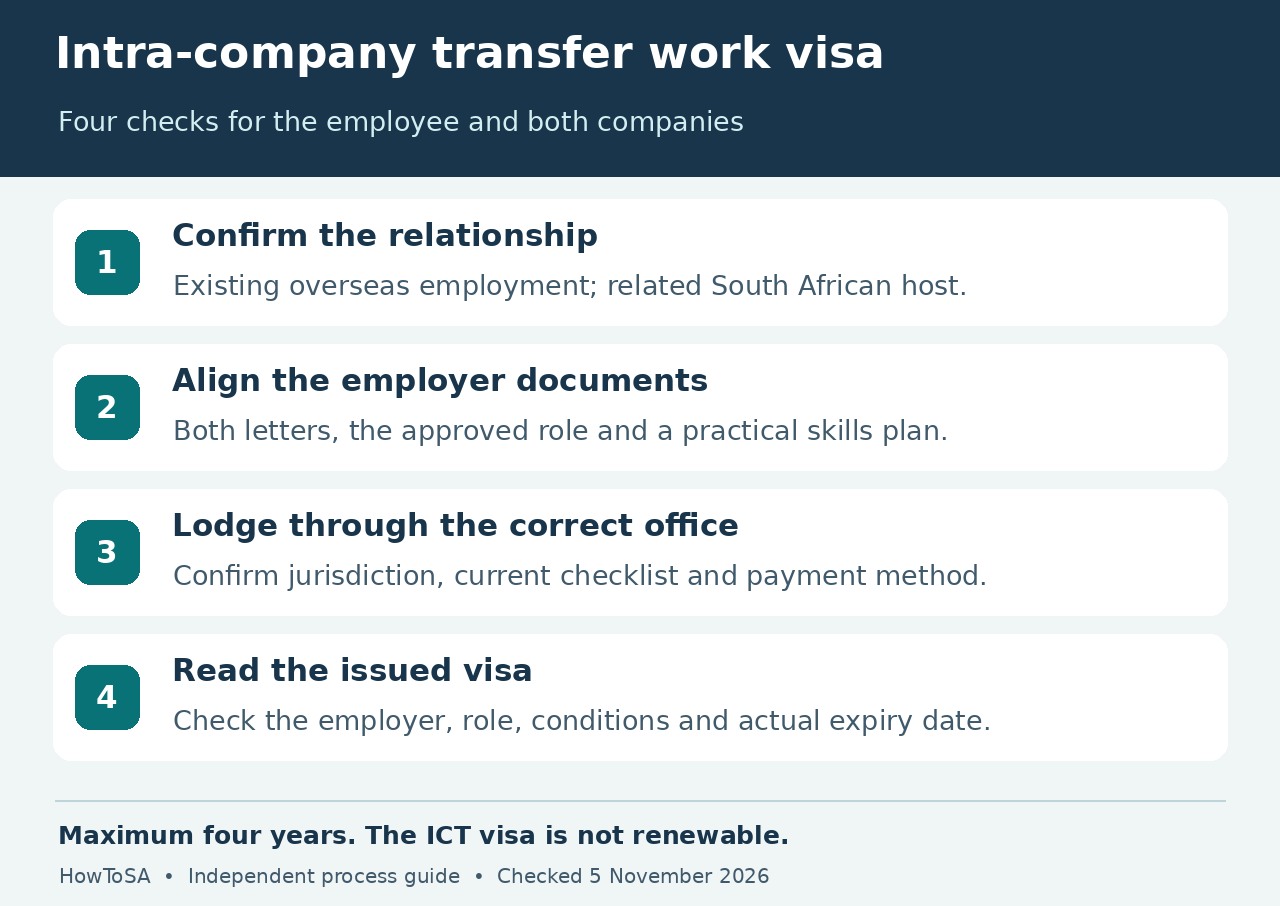
4. Check the applicant’s papers against the local list
Build a residence timeline to identify police certificates and check that each will still be valid on the appointment date. Match names and passport numbers across records; if a name changed, include the evidence the mission asks for. Confirm its requirements for originals, certified copies and translations. Ask which route each dependant needs, including a child who will attend school.
5. Submit the complete application and keep the receipt
Follow the filing office’s appointment and payment instructions. Canberra and Tokyo list personal submission by appointment. If DHA confirms the domestic route applies, use the VFS appointment channel as instructed. Keep the application reference, payment receipt and a copy of the complete submission. Ask how the office will request any missing evidence and return your passport.
6. Track the decision through the filing channel
Use the mission’s instructions for overseas filings or the VFS tracker linked from the domestic checklist for the matching VFS receipt. Use the tracking link on your receipt if it differs. A collection or dispatch message is not an approval. Keep the proposed start date flexible. A receipt gives no new work permission. Under section 10(3) of the Act, a visa issued abroad takes effect after admission to South Africa.
7. Verify the visa and plan for expiry
Compare the issued visa with your passport and assignment: identity, employer, role, validity dates and conditions. Request a correction through the issuing office if anything is wrong. Give HR the actual expiry date and agree when to review the handover. Before a change of employer or role, confirm what permission is needed.
Fees and what they cover
The DHA tariff lists R1,520 for a section 19 work visa. If you are eligible to apply through VFS in South Africa, its dated service fee notice sets the separate charge at R1,750 including taxes from 22 June 2026 wherever a VFS service fee applies. The older category table still shows R1,550. Allow R3,270 when both current charges apply, before any optional services or document costs. Confirm the actual amount and payment method before paying. Overseas missions may publish their own local currency amount and payment instructions. Budget separately for any necessary police records, translations or document authentication.
Processing time, validity and expiry
Ask the receiving office for its current estimate for a complete ICT application. Document preparation, appointment availability, adjudication and passport return are separate stages. VFS says assessment times vary; it cannot decide the application or control the processing time. Do not treat a quote for another visa or mission as your own deadline.
Four years is the maximum validity, not the processing time or a promised visa period. The ICT visa is not renewable. If the business needs a further assignment after a completed four-year transfer, VFS guidance describes a fresh application through a South African mission in the country of origin or permanent residence. It is a new decision subject to the requirements. Confirm your departure and lawful work arrangements before expiry.
Common problems and fixes
- The letters name different entities or occupations: have both signatories reconcile the legal names and approved assignment. Keep evidence of the group relationship available.
- The skills plan is generic: identify the recipient, tasks, training stages and how the host will assess the handover.
- A clearance is missing or has aged out: compare your residence history with the current rule, get the correct replacement and recheck its date before attending.
- The portal cannot find your case: check the receipt for the right tracker and reference. Contact the receiving office with your receipt and submission date before opening a second application.
Official help and refusals
Start with the mission or visa centre that received the file. Give the application category, receipt number, submission date, last status and the specific question. For an unresolved domestic immigration enquiry, see DHA Immigration Services or call 0800 60 11 90 from South Africa. Our work visa follow-up guide has ideas for organising a status enquiry; use the ICT requirements on this page for your application.
If refused, get the written reasons and record the date you received them. Section 8 of the Act provides a review or appeal route for qualifying decisions, with 10 working days from receipt to apply at the relevant stage. Follow the notice and confirm the prescribed channel promptly. A routine status enquiry is separate from filing a review or appeal.
Sources and independence
Checked 5 November 2026 against the linked Act, regulations, DHA tariff, mission guidance and VFS instructions. Read the signed medical-report directive in Government Gazette 55016 for the waiver’s scope.
HowToSA is an independent guide. The receiving office and DHA determine the requirements and outcome for your case.
Accuracy note: Checked 5 November 2026. Uses the 2024 police clearance definition and the July 2026 medical report waiver. Reconciles the current DHA tariff and the 22 June 2026 VFS service fee revision with the older category table. Distinguishes domestic and overseas filing, and ordinary ICT from special schemes. No guaranteed time or automatic continuation is inferred. Editorial review 14 November 2026: DHA intra-company transfer visa fee and June 2026 VFS R1,750 service fee reconfirmed; category-specific and overseas fees may differ.