At a glance
- Typical fee
- Gov.za lists the service as free. R339 is proposed, not verified as an operative export permit charge. September 2026 draft guidelines place export permit fees in a later phase after notice. Confirm ITAC instructions before paying; other costs are separate.
- Processing time
- IE362 states a minimum two working days; ITAC publishes a two-working-day average. Volume, missing evidence and other authorities can add time. No guaranteed overall completion or departure date verified.
- Difficulty
- Moderate
- Authority
- International Trade Administration Commission of South Africa (ITAC); SARS and SAPS for their separate functions
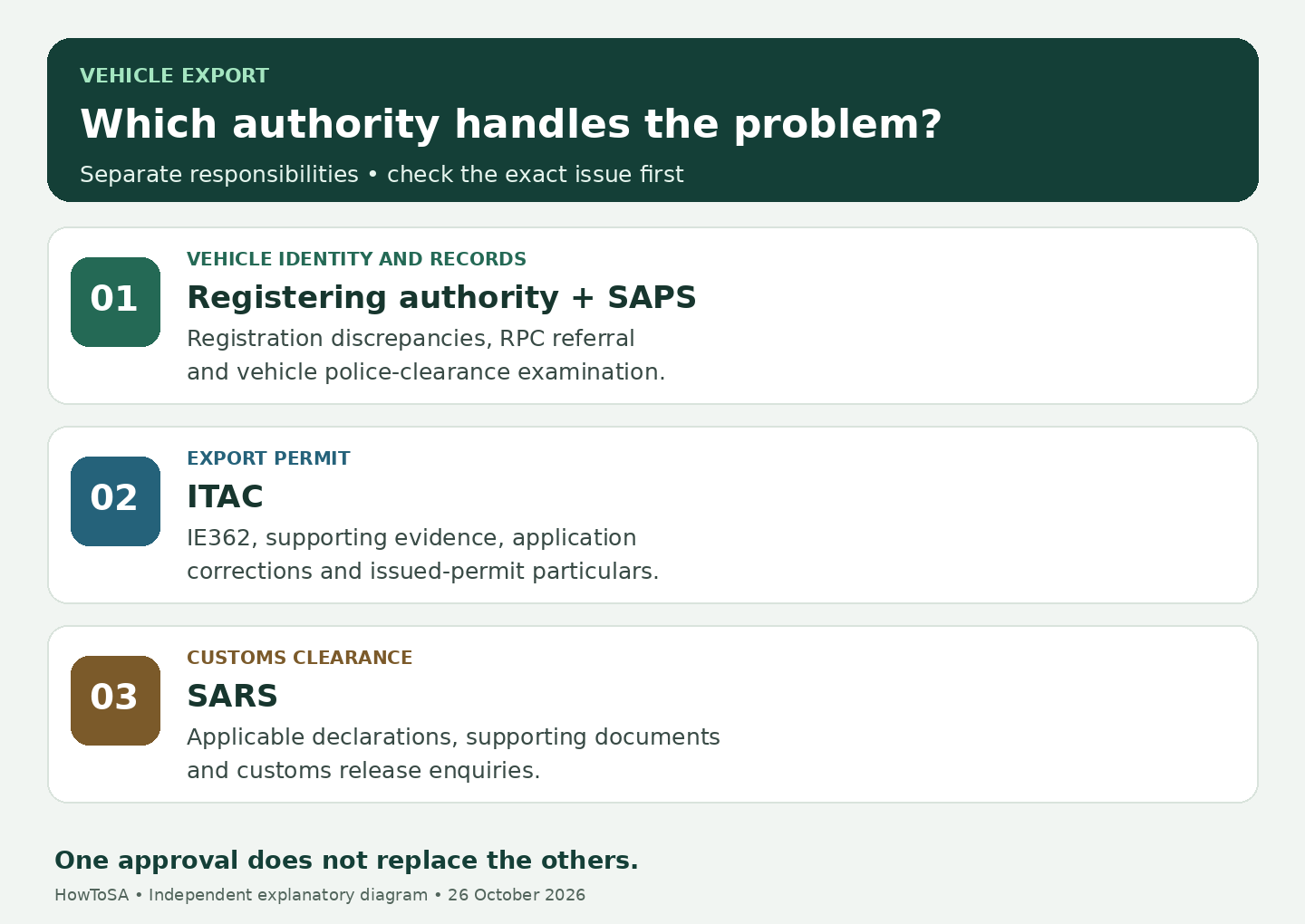
Resolve vehicle export permit problems by finding the exact missing document, incorrect vehicle detail or wrong submission route before applying again. For a used vehicle leaving South Africa, ITAC’s motor vehicle export application is IE362. Vehicle police clearance and SARS customs clearance are separate requirements; one approval does not replace the others. Start with the official ITAC forms directory, then use the checks below.
This guide covers problems with a used motor vehicle export application by a private person or business. It does not decide a destination country’s import eligibility or cover scrap-metal permits. ITAC explains that used vehicle exports are controlled to help prevent stolen vehicles leaving the country. Do not arrange transport on an assumption that a submitted application is an issued permit.
Documents to gather before correcting the application
The current IE362 form lists different supporting evidence:
- Private person: owner’s ID or passport, vehicle registration and vehicle police clearance.
- Applicant not the registered owner: commercial invoice or the seller’s sworn affidavit, plus the seller’s ID.
- Business: IEPS230-b exporter registration, valid company tax compliance certificate, vehicle registration, police clearance and customs code.
Also retain the submitted form, attachments, sent-email record and any ITAC response. Make a list of discrepancies rather than sending an unexplained second bundle. Where a seller’s affidavit is applicable, our South African affidavit guide explains the commissioning process; it does not replace the seller’s required evidence.
1. Identify the authority and the correct application
Write down what has actually gone wrong: no ITAC reply, a returned application, mismatched vehicle records, or a customs release query. These belong to different desks. For motor vehicles, start with IE362 rather than the general-goods IE361. Use the official directory to avoid downloading an unrelated import form from a search result.
A transport operator’s permit is another matter. If the issue concerns operating commercial cross-border transport, consult the temporary cross-border road transport permit guide and the relevant authority. Holding that permit does not establish that ITAC has authorised a particular vehicle’s export.
2. Resolve vehicle identity problems at the source
Compare the registration document against the vehicle identification, engine and registration details in your application. A digit copied incorrectly can create an apparent mismatch. If the underlying registration record is wrong, ask the registering authority how it must be corrected; do not alter a certificate yourself.
SAPS guidance on vehicle clearance describes referral through the registering authority using an RPC, examination at a recognised vehicle clearance office and return to the registering authority for record correction. The official Cape Town RPC example includes vehicle identity fields and an export reason. Confirm the local referral and inspection arrangements before travelling. A personal criminal-record clearance certificate is a different document.
3. Repair ownership and business evidence
Make the relationship between the registered owner, seller, exporter and person completing the application clear. If those names differ, check the IE362 supporting-document list before resending. An invoice should identify the relevant transaction and vehicle clearly enough for the official to understand the ownership chain.
For a business, compare its particulars with the IEPS230-b exporter registration form, including the customs code, business and contact details and authorised declaration. Ask ITAC what tax-compliance evidence it currently accepts if you cannot supply the certificate described on IE362. Do not assume a company registration number, tax number and customs code are interchangeable.
4. Complete a clean, consistent IE362
The form requires typed entries or block capitals and warns against incomplete applications, alterations and erasures. Prepare a clean replacement where necessary. Check the year, make, engine/chassis numbers, registration, colour, export port, value and other requested fields against your supporting records. Sign and date the application.
If a field is unclear, ask the responsible official what to enter instead of guessing. Keep a copy of the exact corrected version. Use legible scans with all page edges visible, and sensible filenames so the reviewer can distinguish registration, clearance and ownership evidence. This organisation is practical advice, not a separate official form requirement.
5. Submit through the official export-control route
ITAC’s working arrangements prefer email to the responsible officials and discourage distributing duplicate applications widely. Its contact directory lists Jeremia Jele, jjele@itac.org.za, and Isaac Malepane, imalepane@itac.org.za, for motor vehicle exports. Recheck the directory when submitting because responsibilities can change.
Identify whether this is a first submission or a correction, and include the earlier reference if one exists. A useful subject identifies the vehicle-export application and your reference; keep identity documents within the official submission rather than public messages. Explain the precise correction and list the attachments. Retain the sent message, delivery failure notices and any acknowledgement.
6. Check the issued permit and separate customs requirements
When a permit arrives, compare its vehicle and exporter particulars with your records and read its conditions and validity dates. Report an error to ITAC before relying on it for transport. An acknowledgement or application reference alone is not the permit.
SARS export guidance separately addresses declarations and supporting documents, including permits where goods are restricted. Ask SARS or your clearing agent which registration or client-code arrangement and declaration apply to your circumstances. Confirm destination-country entry requirements with that country’s authorities. Neither an ITAC permit nor this guide guarantees customs release or admission abroad.
Fees and timing: avoid an outdated promise
Fees checked on 26 October 2026: the government service page lists the service as free. ITAC’s newer fee page labels R339 for an export permit as proposed. Its 21 September 2026 draft guidelines anticipate an April 2027 start for specified APDP certificates, with export permits later after notice. The August regulations establish the framework. We did not verify an operative export-permit charging date. Confirm current instructions with ITAC before paying; private-agent, transport and other authorities’ costs are separate.
Timing: IE362 states a minimum of two working days; ITAC’s general export page describes two working days on average. Neither is a guaranteed departure date. Its 12 June 2026 notice warns that high application volumes affect replies and turnaround. Missing evidence, inspections and corrections can add time. No universal overall completion period was verified.
Common vehicle export permit problems and fixes
- Wrong form: return to the motor vehicle application in ITAC’s official directory.
- Unreadable or missing attachment: check the sent files themselves, then supply a complete legible copy with an explanation.
- Owner names differ: establish which supporting seller documents are missing.
- Vehicle identifiers disagree: separate a copying error from an incorrect registration record and involve the registering authority where needed.
- Email bounced: keep the failure notice, recheck the current contact and correct the delivery problem.
- Permit issued but customs stopped the vehicle: obtain the precise customs query and reference; ask which declaration, document or permit condition remains unresolved.
Official follow-up and escalation
Follow up with the responsible motor vehicle official using the original submission date, exporter details, reference and a short description of the outstanding action. Attach relevant previous correspondence. If a refusal is unclear, request the reason and the evidence or correction required. Do not assume that repeatedly submitting the same file changes the decision.
For an unresolved export-control service enquiry, the current ITAC directory identifies Export Control manager Dudu Mogale, dmogale@itac.org.za. Summarise earlier attempts and the response sought. A manager enquiry is not a promise of approval or a substitute for any formal remedy stated in a decision.
For customs matters, use the SARS customs resolution process: 0800 00 7277, option 4. Supply the customs reference, declaration or movement reference where relevant, and retain the enquiry reference. Direct vehicle-record or police-clearance problems to the registering authority or SAPS clearance office handling them.
Official and primary sources checked
Checked on 26 October 2026. Fee proposals and processing benchmarks are qualified above; confirm case-specific instructions with the responsible authority.
- South African Government: register as an exporter
- ITAC: export control
- ITAC: export control application forms
- ITAC IE362: motor vehicle export permit application, October 2024
- ITAC IEPS230-b: registration as an exporter
- ITAC: export control working arrangements
- ITAC: export control contact details
- ITAC: important notice on import/export permit applications, 12 June 2026
- SAPS: vehicle police clearance FAQ
- City of Cape Town: request for police clearance (RPC)
- SARS: exports
- SARS: customs resolution process
- ITAC: schedule of proposed administrative fees
- Government Gazette 55427, Notice 4158: draft administrative fees guidelines, 21 September 2026
- Government Gazette 55255, Notice R7850: administrative fees regulations, 28 August 2026
HowToSA is an independent information site, not ITAC, SARS, SAPS or a registering authority. This guide is general information. Official requirements, permit conditions and case-specific decisions take precedence.
Accuracy note: 26 October 2026: confirmed IE362 used-vehicle export troubleshooting as distinct from cross-border transport permits. Checked documents, current contacts, delay notice and customs escalation. Distinguished proposed R339 fees and phased implementation from current charging; no unsupported expiry, export deregistration instruction or approval guarantee supplied.